
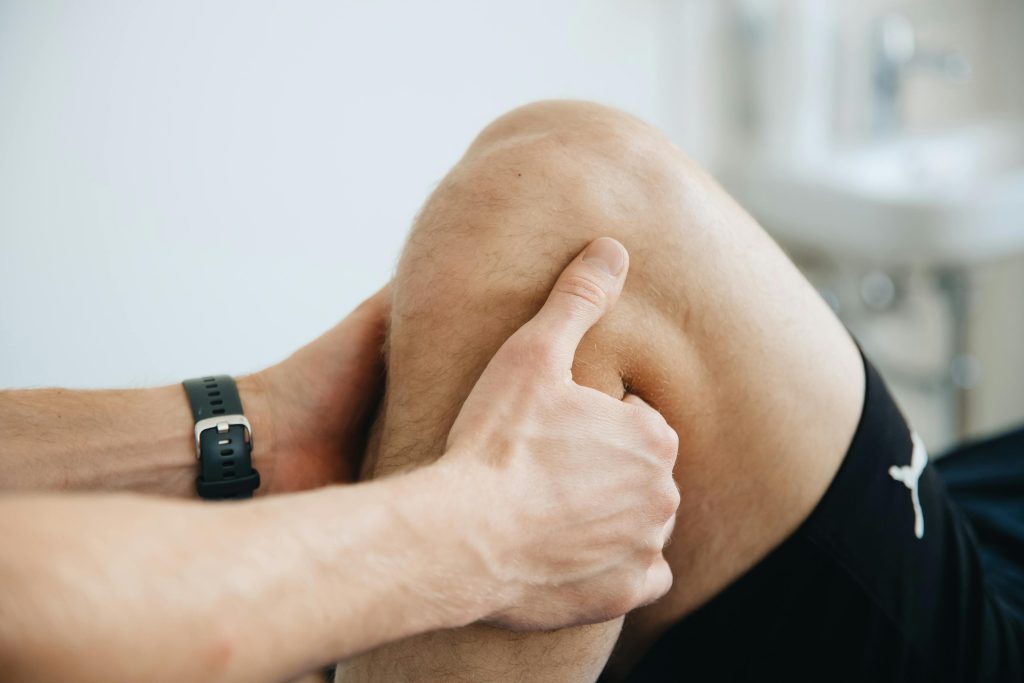
A twist, a knock to the outside of the knee, or a heavy tackle can leave you with pain on the inner side of the knee and a feeling that it won’t hold. That is a typical picture of a medial collateral ligament (MCL) injury. The good news is that most MCL injuries recover well with the right rehabilitation. This guide covers what the MCL does, the symptoms, the grades of injury, realistic recovery times and how physiotherapy helps.
What is the MCL?
The medial collateral ligament runs along the inner side of the knee and stops the joint from buckling inwards. The medial ligament complex includes the superficial MCL, the deep MCL and the posterior oblique ligament [1]. Medial ligament injuries are among the most commonly injured knee ligaments [1].
What causes an MCL injury?
MCL injuries usually happen when the knee is forced inwards (a valgus force) or the shin rotates outwards [4]. Common situations include:
- A direct blow to the outside of the knee, as in football or rugby
- Sudden changes of direction, as in netball or skiing
- Awkward landings, twists or slips in everyday life
Symptoms of an MCL injury
Symptoms depend on severity but commonly include [5]:
- Pain on the inner side of the knee
- Swelling and stiffness
- A feeling of instability, especially on stairs or when changing direction
- Difficulty fully straightening the knee
- Locking or giving way
The three grades of MCL injury
MCL injuries are graded by how much of the ligament is damaged [4]:
- Grade 1: a mild sprain with little fibre damage. Pain is usually low and it typically settles within a couple of weeks [6].
- Grade 2: a partial tear with more fibres damaged, often with bruising, swelling and a feeling of instability. It is usually treated without surgery, with rehabilitation over roughly 6–12 weeks [6].
- Grade 3: most or all of the fibres are torn. There is often considerable swelling, bruising and difficulty bearing weight [6].
How is an MCL injury diagnosed?
A physiotherapist or doctor can usually diagnose a knee ligament injury from your history and a physical examination, which includes stress-testing the ligament for laxity. X-rays or scans may be requested to rule out a fracture or cartilage injury, or to plan surgery [7].
Do you need surgery?
Usually not. A systematic review of randomised controlled trials found that non-operative treatment gave similar functional outcomes to surgery for grade 1–3 MCL injuries. It was also linked with better quadriceps strength during rehabilitation and fewer complications [1]. Grade 3 injuries that occur on their own are often managed in a similar way to grade 1 and 2 [3].
Surgery is more likely to be considered when the MCL is torn together with other ligaments, such as the ACL, or when the knee stays unstable [3]. When both are injured, the usual approach is to rehabilitate the MCL first, with ACL reconstruction considered once the MCL has healed, often around 5–7 weeks after injury [4].
MCL injury recovery time
Recovery varies with the grade, your activity level and whether other structures are involved. As a general guide:
- Many knee sprains recover in 2–3 weeks, and some take up to 6 weeks to feel fully comfortable [5]
- Grade 2 injuries typically need around 6–12 weeks of rehabilitation [6]
- Combined injuries take longer and need an individual plan
If there is no improvement after 4–6 weeks of physiotherapy, further investigation such as an MRI may be considered [5].
Early management: the first few days
In the first 48–72 hours, the aim is to protect the knee and settle swelling and pain [5]. That usually means:
- Protecting the knee, with a support or crutches if needed
- Relative rest, keeping to pain-free movement
- Ice, compression and elevation to manage swelling
Early movement matters. Evidence suggests that prolonged immobilisation can lead to weaker ligament healing, which is why early range-of-motion work is a central part of rehabilitation [3]. A systematic review also found that weight bearing and walking were feasible straight after grade 1 and 2 injuries when tolerated [2]. Because a more serious tear can look similar, it’s best to get the knee assessed rather than self-diagnose anything beyond a mild strain [6].
How physiotherapy helps
Rehabilitation is the mainstay of treatment for MCL injuries [3]. A structured programme typically progresses through overlapping stages [3][4]:
- Settle and protect: manage pain and swelling, restore gentle movement, and wake up the thigh muscles early with pain-free quadriceps activation [6].
- Restore movement and strength: progressive strengthening of the quadriceps and hamstrings once pain allows weight bearing [3].
- Balance and control: proprioception, single-leg control and stability work to rebuild confidence in the knee.
- Return to activity: graded return to walking further, running, sport or work, based on how the knee responds rather than a fixed date.
Supervised strengthening and coordination training also matters for the long term. Sticking to a properly supervised programme significantly reduces the chance of ongoing knee pain and instability [7].
Your physiotherapist will also check for associated injuries, decide whether a brace is appropriate, and adjust your programme as you progress. Research on exactly how MCL rehabilitation should be delivered is still developing, which is why an individualised approach guided by an experienced clinician is important [2].
When to seek urgent medical help
Get the knee assessed promptly, and attend A&E if you cannot weight-bear at all, the knee looks deformed, it is locked, or you have significant swelling, numbness or a cold, pale foot after an injury.
MCL injury physiotherapy in Sutton Coldfield
At Four Oaks Physio, our Chartered Physiotherapist has over 25 years of experience treating knee and sports injuries. We offer thorough assessment, hands-on treatment, electrotherapy, tailored rehabilitation programmes and, where appropriate, medical acupuncture for pain relief. Appointments are available in clinic or as a home visit across Sutton Coldfield and surrounding areas, with no waiting list.
Call 07894 988812 or book an appointment online and start your recovery.
Related reading: Knee pain physiotherapy in Sutton Coldfield | Home visit physiotherapy | Knee replacement rehabilitation | Medical acupuncture
This article is for general information and does not replace individual assessment. If you have a knee injury, seek advice from a qualified healthcare professional.
References
- Systematic review of randomised controlled trials for interventions to treat injuries to the medial ligaments of the knee. 2020. PubMed. https://pubmed.ncbi.nlm.nih.gov/32349920/
- Svantesson J, Piussi R, Weissglas E, et al. Shedding light on the non-operative treatment of the forgotten side of the knee: rehabilitation of medial collateral ligament injuries, a systematic review. BMJ Open Sport & Exercise Medicine. 2024. doi:10.1136/bmjsem-2023-001750. https://www.ncbi.nlm.nih.gov/pmc/articles/PMC11202733/
- Review: Medial collateral ligament injuries. PMC. https://pmc.ncbi.nlm.nih.gov/articles/PMC5581380/
- Medial Collateral Ligament Injury of the Knee. Physiopedia. https://www.physio-pedia.com/Medial_Collateral_Ligament_Injury_of_the_Knee
- Knee injury patient information. South Tees Hospitals NHS Foundation Trust. https://www.southtees.nhs.uk/?p=18854
- Knee ligament injuries. Swansea Bay University Health Board (NHS Wales). https://sbuhb.nhs.wales/hospitals/a-z-services/physiotherapy/musculoskeletal-physiotherapy/knee-pain/knee-ligament-injuries/
- Knee ligament injury FAQs. Circle Health Group. https://cic.circlehealthgroup.co.uk/msk/knee-ligament-injury/